

INTRODUCTION
A leading North American bulk container services company needed more than an off-the-shelf tracker. They required a custom, cost-effective solution to monitor thousands of high-value assets across yards, job sites, trains, and even ships. The challenge? Deliver the right mix of durability, battery life, and scalable service cost, while providing just enough actionable data to improve day-to-day operations (e.g., Where is it? Has it moved? Has it been serviced?). Indesign stepped in to engineer a solution that proved why sometimes, off-the-shelf isn’t good enough.
ISSUE
As the project moved from concept to field trial, several issues shaped the design:
- Evolving requirements: Internal stakeholders needed different reporting cadences (some weekly, others hourly) for assets in motion (e.g., on trains), making battery life and data cost a moving target.
- Total cost of ownership: Hardware price and monthly connectivity fees had to stay low to make tracking the assets viable at scale.
- Battery longevity: Devices needed to operate 3-5 years without battery replacement, even in harsh conditions.
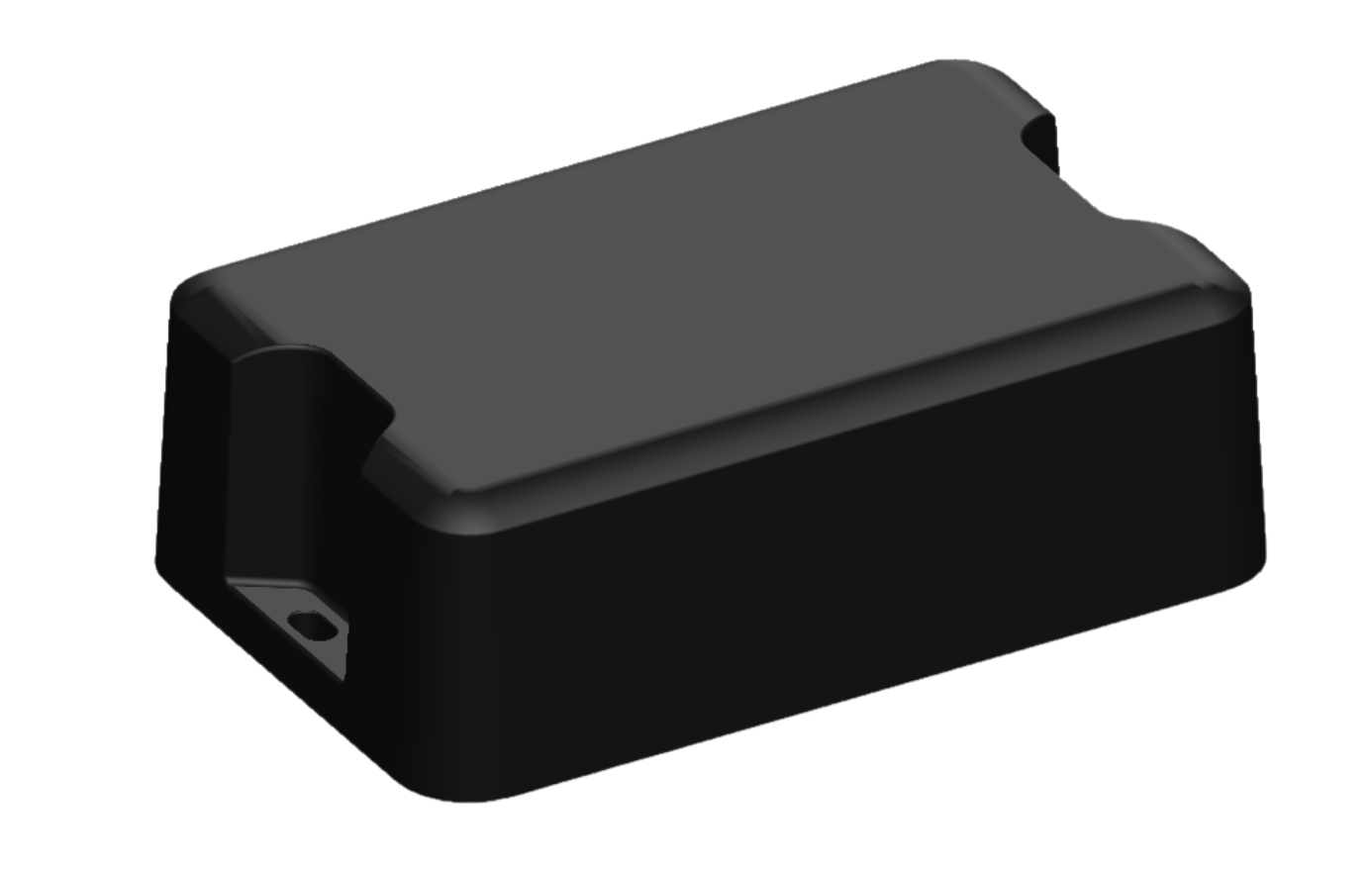
- Durability and environmental exposure: Housings had to tolerate impacts, weather, and rough handling without attracting attention.
- Operational maturity: Testing the system end-to-end (cellular network, cloud interface, and dashboards) required multiple field trials and iterations before entering production.
IMPLEMENTATION
Indesign delivered a custom asset tracker and data pipeline through a staged, collaborative approach:
- Low-power hardware architecture: A Nordic cellular/GPS system-on-chip paired with an accelerometer and an ultra-low-power timing circuit enabled the device to sleep most of the time and wake only when needed.
- Smart reporting: The firmware implements a “wake-check-report” logic: the device wakes on a schedule, acquires the GPS location, and reports the location to the cloud. An accelerometer can also wake up the device if movement is detected. By skipping unnecessary GPS fixes and cellular sessions, the design dramatically extends battery life.
- Iterative field trials: Multiple pilot phases refined update rates (hourly vs. daily), explored Wi-Fi fallback scenarios, tested enclosure durability, and validated cloud ingestion and visualization. Feedback loops with operations informed each electrical, firmware, and mechanical revision.
- Cross-disciplinary collaboration: Electrical, firmware, mechanical, test, and systems teams coordinated closely, integrating device behavior with cloud services and practical dashboards for asset location and status.
- MVNO and Carrier Certification: For early prototypes, an MVNO provider was used for cellular connectivity. Moving into larger field trials and into production, Indesign took the device through PTCRB certification for Verizon, AT&T, and T-Mobile. This ensured reliable connectivity, regulatory approval, and seamless integration with multiple networks.
- Manufacturing transition: After early builds (hundreds of units), production processes were established, enabling scale to thousands through a U.S. factory and a more standardized BOM supporting lower unit cost at higher volumes.
ANTICIPATED IMPACT
- Custom beats off-the-shelf: A tailored design ensures that the tracker has every feature needed for the company’s unique operational needs without all the often costly “bells and whistles” of off-the-shelf options.
- Operational visibility: Routine location updates and movement-based reporting reduced manual checks and helped identify misplaced or idle assets.
- Scalable economics: Architecture choices supported low recurring data cost and predictable battery life, improving long-term viability at fleet scale.
- Ongoing roadmap: Positive outcomes led to a planned Gen-2 program targeting 2026, focused on tighter requirements, additional features, and higher-volume manufacturing (hundreds of thousands).
INSIGHT
Flexibility Drives Custom Solutions
This project proved that when off-the-shelf options fall short, success depends on adaptability. Indesign embraced evolving requirements and delivered a custom tracker that balanced battery life, durability, and cost. For organizations with unique operational needs, the journey of iteration, guided by disciplined architecture, can unlock innovations that generic solutions simply can’t provide.