

INTRODUCTION
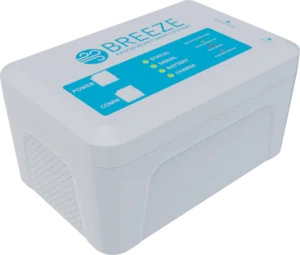
Breeze serves the environmental testing needs of home inspectors, providing devices that support radon and other health‑related measurements. When preparing for the fourth generation of its flagship radon monitor,
Breeze set out to transform the device from an off‑the‑shelf module‑based product into a high‑performance, custom‑engineered platform that would lead the industry in sensitivity, battery life, and ease of use. Indesign was selected for its expertise in low‑power cellular devices, RF engineering, PCB design, and
embedded firmware.
ISSUES
Previous generations of the Breeze radon monitor successfully disrupted the market but revealed several constraints that limited scale:
- Power limitations. The prior generation delivered ~70 hours of battery life, with longer than desired charge times.
- Sensitivity & performance. Sought a major leap forward in sensitivity, using a new pulsed‑ionization sensing method.
- Size & portability. Inspectors typically deploy 10+ devices across multiple vehicles. Size affects storage, handling, and job efficiency.
- Tight mechanical constraints. Fit a motor, PCB, battery, LEDs, and wireless hardware within the limited geometry of a bottle‑compatible enclosure.
- High cellular costs. Previous devices incurred monthly cellular costs that made scaling difficult.
- Tight timeline. The team required a fast, coordinated development process to bring the product to market as quickly as possible.
- Certification challenges. Radon monitors undergo humidity‑stress testing and specialized certification, requiring iterative debugging between the Breeze sensor board and Indesign’s electronics.
IMPLEMENTATION
- Custom architecture & team roles. Breeze and Indesign co‑developed with a split engineering model designed for speed and deep domain knowledge alignment:
- Indesign: electronics architecture, component selection, PCB layout, RF/antenna engineering, board‑level drivers, cloud interface, OTA updates.
- Breeze: pulsed‑ionization sensor board, mechanical enclosure, application-level firmware, system‑level testing.
- Low‑power hardware strategy. Choosing the Nordic nRF91 platform enabled exceptionally low sleep currents and reliable cloud connectivity, critical for multi‑hundred‑hour runtimes. Breeze noted this as a major differentiator.
- Proximity‑driven co‑engineering. With the teams only minutes apart, collaboration happened continuously with weekly onsite sessions, rapid prototype swaps, and parallel debugging. Indesign also built two full prototype runs (V1 and V2) to accelerate testing.
- Connectivity overhaul. Indesign replaced a legacy third‑ party cloud interface with a direct cloud connection, allowing Breeze to own the IP and reduce monthly cellular costs.
- Manufacturing enablement. Indesign supported Breeze’s contract manufacturer by refining DFM recommendations, providing test firmware, and ensuring readiness for higher‑volume production.
ANTICIPATED IMPACT
- Industry-leading battery life. Increased from 70 hours to 500 hours, a 7x improvement.
- Fast, reliable charging. From 0 to 100% in roughly 2.5 hours vs. 10–12 hours previously. This enables same‑day redeployment.
- Top‑tier radon sensitivity. The new pulsed‑ionization method, paired with stable low‑noise electronics, positions the Gen 4 unit as one of the most sensitive monitors in its class.
- Strong market position. The Gen 4 radon monitor positions Breeze for substantial growth. Breeze anticipates an increase in market share growth and sees a long‑term competitive advantage because their subscription model avoids replacement cycles that competitors rely on.
- Accelerated time‑to‑market. Indesign delivered its scope in about seven months, keeping Breeze in front of the industry.
INSIGHT
Where Bold Vision Meets Seamless Execution
This project demonstrates how quickly a product can advance when two engineering teams work with shared intent and close collaboration. Breeze came in with a bold vision, and Indesign helped turn that ambition into a practical, high‑performance platform that resets expectations for professional radon monitoring.
Key choices made early in the program unlocked the biggest gains: consolidating connectivity to give Breeze full ownership of cost and IP, committing to a purpose‑built low‑power architecture, and structuring collaboration so
hardware, firmware, and sensor development moved in parallel rather than in sequence. This alignment allowed the teams to make complex decisions faster, reduce uncertainty, and keep momentum throughout an aggressive schedule.
What emerged is more than a next‑generation device. Breeze now has a scalable technical foundation, a cloud architecture it fully controls, and a product experience that strengthens its leadership position nationwide. The success
of the radon monitor reflects not only thoughtful engineering but a partnership defined by responsiveness, openness, and a shared drive to deliver something truly best in class.