

INTRODUCTION
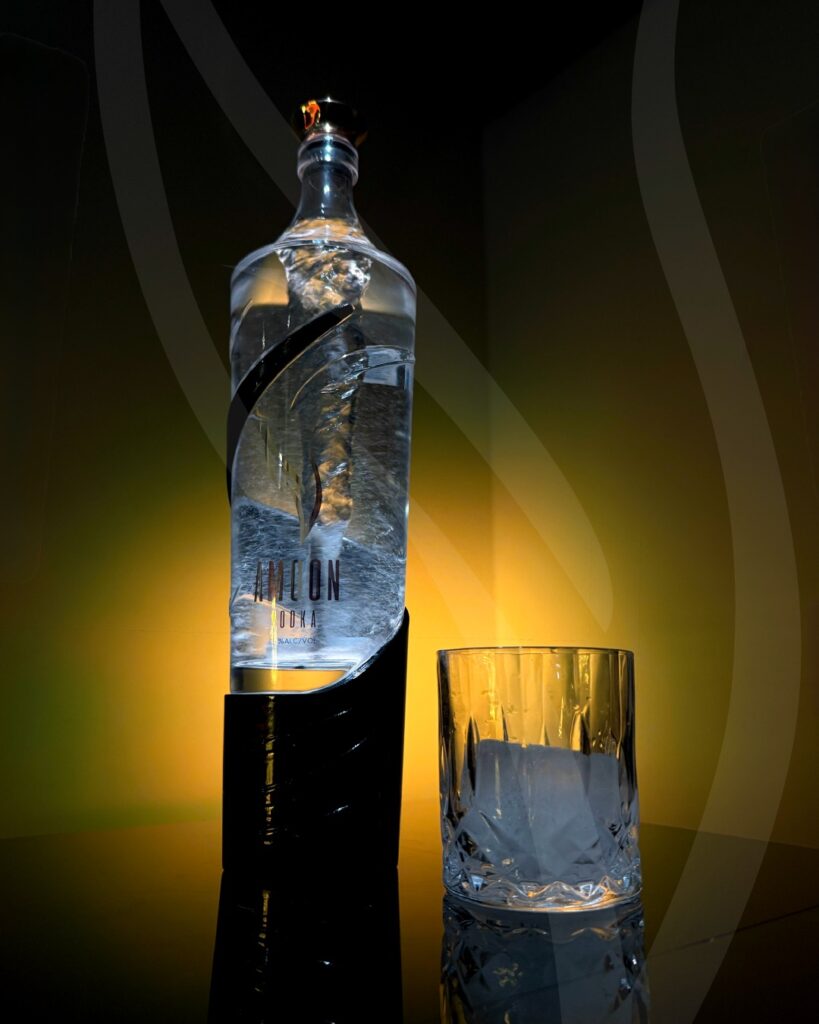
Amoon Spirits set out to create an entirely new category within the spirits industry: a connected liquor bottle that blends premium vodka with embedded electronics, lighting, motion, and mobile interactivity. Their signature “Vortex Bottle” concept combines illuminated animations with an internal magnetic stir system that creates a visible swirling vortex on command.
To bring this vision out of early prototype form and into a path toward manufacturing, Amoon partnered with Indesign to lead Phase 2 engineering: refining requirements, maturing the electronics and mechanics, integrating with external app developers, and delivering fully functional prototypes.
ISSUES
Introducing a tech‑enabled liquor bottle posed a unique blend of electrical, mechanical, and system‑integration challenges:
- Tight mechanical constraints. Fit a motor, PCB, battery, LEDs, and wireless hardware within the limited geometry of a bottle‑compatible enclosure.
- Wireless responsiveness. Ensure low‑latency communication so lighting and vortex effects update instantly when the user changes settings in the app.
- Cross‑team integration. Seamlessly connect Indesign’s embedded hardware/firmware with Outside Source’s mobile application.
- Requirements uncertainty. Early concept prototypes required structured review and refinement to establish clear, actionable engineering requirements.
- Prototyping-to-manufacturing needs. Move from early proof‑of‑concept to robust prototypes optimized for manufacturability and vendor evaluation.
- System validation. Verify battery life, vortex performance, lighting behavior, connectivity reliability, and pre‑compliance (ESD/FCC).
IMPLEMENTATION
Indesign executed a structured, multidisciplinary Phase 2 development program to mature the Vortex Bottle into an integrated hardware platform.
- Requirements refinement. Joint review sessions with Amoon Spirits ensured alignment on system behavior, performance goals, and manufacturability expectations. Clarified interfaces between hardware, firmware, and the mobile application.
- Electrical & firmware engineering. Developed schematics, PCB layout, and full electronics BOM. Implemented a chip‑down wireless solution providing stable connectivity and OTA update capability. Created motor‑control firmware enabling smooth, controllable vortex patterns.
- Mechanical engineering. Built detailed mechanical CAD for bottle components and wraps. Leveraged 3D scan data to optimize fit, assembly, and manufacturability. Addressed thermal, spatial, and structural constraints for internal components.
- Prototype builds. Delivered two complete prototype iterations (V1 and V2). Produced ten fully functional, closed V2 prototypes that closely represented the intended production design.
- App integration. Collaborated with Outside Source to design and validate communication between the bottle hardware and the mobile app. Ensured lighting and vortex behaviors responded instantly to user inputs.
- System testing & pre‑compliance. Performed functional, stability, and battery‑life testing. Conducted ESD and FCC pre‑compliance checks to reduce downstream risk. Validated performance across lighting modes, vortex intensities, and wireless operations.
ANTICIPATED IMPACT
- Clear, validated requirements. Established a stable foundation for ongoing development and manufacturing transition.
- Manufacturability. Refined electrical and mechanical designs positioned the product for a seamless handoff to contract manufacturing and production scaling.
- Prototypes that demonstrate the full experience. Ten V2 units allowed Amoon Spirits to conduct user testing, secure internal alignment, and prepare for market introduction.
- A foundation for an expandable platform. The validated hardware system supports future product variations and interactive features through software updates.
INSIGHT
Integrated Engineering Enables Market‑Ready Innovation
The Vortex Bottle presented a complex challenge: transforming an experience‑driven, technology‑rich concept into a product system grounded in real‑world performance and manufacturability. Phase 2 engineering advanced and integrated core features while validating their behavior, reliability, and system‑level interactions under production‑relevant conditions.
Through coordinated mechanical, electrical, and systems engineering, Indesign helped evolve the Vortex Bottle from an inventive prototype into a cohesive, production‑informed platform. Key features were refined through functional testing and disciplined tradeoffs, resulting in an architecture aligned with scalability and long‑term reliability.
The outcome of this phase is a validated technical foundation—complete with tested functionality, defined system requirements, and informed design constraints— that solidifies the Vortex Bottle as a cohesive, production‑ready platform defined by validated performance and disciplined system design.