

INTRODUCTION
A leading building materials manufacturer set out to launch a new product category: electrically switchable glass that transitions between clear and frosted states on demand. This technology offers instant privacy and dynamic light control for environments ranging from homes and offices to healthcare and hospitality.
To make this vision real, the client needed more than basic hardware. They required a centralized control platform capable of managing dozens, and eventually hundreds, of glass panels individually, while integrating with modern automation systems and cloud services. Existing solutions were fragmented and lacked scalability, so the challenge was to deliver a robust, compliance-ready system that could handle high voltages safely and provide a seamless, intuitive user experience.
ISSUES
Introducing electrically controlled glass into architectural spaces was challenging on many levels. The solution had to combine high-voltage electronics, distributed control, and smart integration while meeting strict compliance standards and scaling from single-panel applications to multi-room installations.
- High-voltage compliance: Drive glass at significant voltages without emitting radio interference; meet FCC radiated emissions requirements.
- Scalability: Control hundreds of panels individually, while remaining modular for smaller installations.
- Smart integration: Support scheduling, app-based control, local UI, and building automation interfaces.
- Reliability & safety: Tolerate wiring faults (opens/shorts), protect against misuse, and sustain long-term operation.
- Manufacturing complexity: Move from iterative prototypes to factory production amid supply chain constraints.
IMPLEMENTATION
A structured, end-to-end delivery approach producing a turnkey platform:
- Systems architecture: A Linux-based main controller orchestrates scheduling, UI, and network services; distributed microcontrollers handle real-time, per-panel control.
- High-voltage drive electronics: Custom waveforms and protection circuits minimize radiated emissions while delivering stable, flicker-free switching.
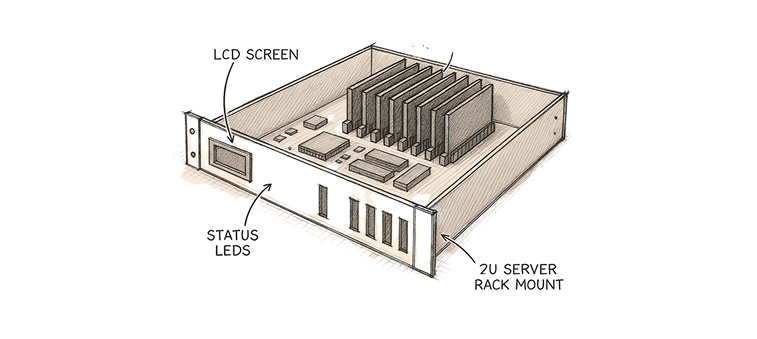
- Modular hardware: A rack-mount multi-slot backplane accepts channel cards in flexible quantities; the chassis can be daisy-chained to accommodate large installations.
- Smart interfaces: Local LCD/touch UI, cloud-connected remote control, and integration hooks for building automation systems.
- Safety & fault tolerance: Per-channel sensing detects wiring faults and abnormal loads; firmware safeguards prevent damage under miswiring or short-circuit conditions.
- Prototyping & validation: Phased pilots progressed from open to closed chassis builds, including thermal characterization and EMI pre-compliance testing.
- Manufacturing transition: DFM/DFT, test fixtures, and BOM stabilization enabled ramp at the factory; supply risk managed through part alternatives and lead-time planning.
- Portfolio strategy: The multi-channel platform informed a single-panel variant, expanding addressable use cases without the need for redesign.
ANTICIPATED IMPACT
- New product category—and faster. The platform enabled the client to offer switchable glass with a complete control solution instead of just raw materials.
- Operational reliability. Architecture and protections reduce service calls and installation risk.
- Design flexibility. One platform spans large conference areas and single-panel entryways without bespoke electronics per job.
- Integration-ready. Scheduling, local UI, and cloud hooks meet modern building expectations.
INSIGHT
Complexity Demands Integrated Expertise
Introducing a transformational electronic product into a deeply established and slow-changing industry requires market and industry know-how combined with engineering and manufacturing expertise. The challenge becomes even more complex when high-voltage compliance, cloud connectivity, and modular hardware converge, and this is where depth across disciplines becomes the differentiator.
By integrating electrical, firmware, mechanical, and compliance engineering into a single, coordinated team, Indesign eliminated gaps that typically derail complex programs. For organizations entering new technology markets, this level of integration turns ambitious concepts into market-ready solutions.